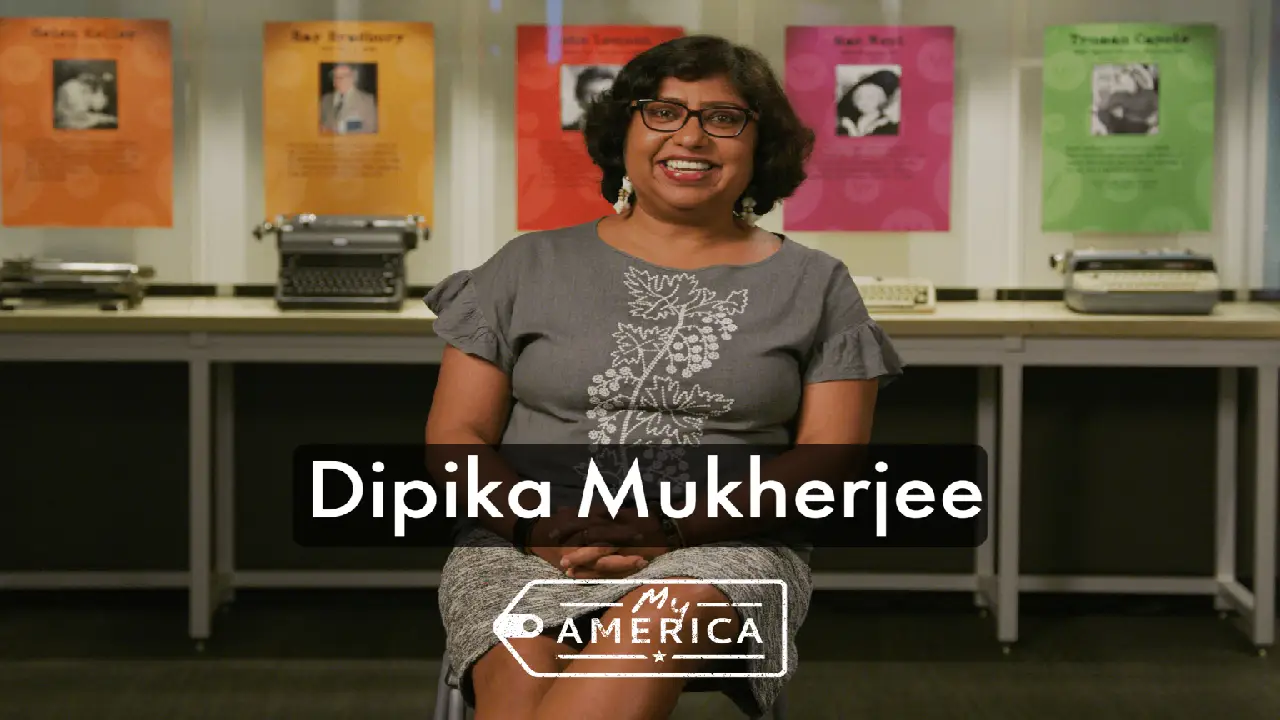

Each week, the My America blog series introduces you to one of the writers featured in our special exhibit My America: Immigrant and Refugee Writers Today. The exhibit is designed to elicit thoughtful dialogue on a wide array of issues with contemporary immigrant and refugee writers delving into questions about writing influences, being multilingual, community, family, duality, otherness and what it means to be American. Check back every week to learn more about these writers and their thoughts on these themes, as we highlight select quotes from the exhibit as well as reading recommendations. Author and professor Dipika Mukherjee is our featured writer today. Mukherjee also was a member of the curating team for My America and was instrumental in getting this exhibit off the ground.
Dipika Mukherjee
Dipika Mukherjee
When she was a child, Dipika Mukherjee’s father was a diplomat so they traveled around the world a lot, living in different cities from Geneva to Jakarta to Wellington, New Zealand. This exposed Mukherjee to many different languages, which has impacted her writing and life. After all, she did first come to the United States to study for a PhD in sociolinguistics. And though she did not always know the native language of the city her family was living in, through writing and reading she was able to find comfort. “Writing in a way was the only thing that always spoke my language. And libraries were the same. I could walk into a library, pretty much anywhere in the world, and you would have an English section.”
The many different types of people and places Mukherjee has seen has also greatly impacted her writing. She likes to write about travelers, wanderers, immigrants or people who are “just generally moving through a space that helps them grow.” And because she has seen and interacted with so many different people from so many different countries and cultures, Mukherjee is very conscious about illustrating the multitudes and complexity of her characters:
“One of the things that strikes you as a traveler, very early, is that no place is perfect…you realize that people are not black or white. They are so multifaceted. And the world is just amazing. So one of the things that I’m trying to do [in my writing] is not contouring my villains or my heroes or heroines in a certain way, because people are just not like that. And places are not like that.”
We interviewed Mukherjee for our special exhibit My America: Immigrant and Refugee Writers Today, which also exemplifies the wide range of voices, cultures, customs, and experiences we see in this country, and the world at large. You can read excerpts from this interview below, and check out the exhibit in person to hear and see even more from Mukherjee and other writers. Plan your visit today!
Shambala Junction by Dipika Mukherjee
View the full My America reading list here.
Selected Quotes from My America
On Home
“The idea of home is very fluid for me. It is a place which doesn’t make me feel like I want to leave. And whether that is right now in Chicago or, if we move to say Texas, it might happen to be Texas. That’s just the way it is. And I’m happy being like that because the world is just such a large, wonderful place and I feel that there’s still so much I haven’t experienced…I think you can make any place a home, you really can, if your mind is open to embracing the communities that are there.”
On Advice to Young Writers
“Enjoy the writing. Don’t think about whether you’re getting the words right, just write…The joy of writing, of getting your thoughts out there, that is something I want all young writers to feel. Just the absolute sheer exhilaration that comes from being able to get what is in your mind down in a way that other people can read, and then it touches their hearts. So if you have a story to tell, just do it, in whichever language that comes to you. Or a mix of them. It’s fine.”